
TravelTips24 : East Asia : China
China
China (中国 Zhōngguó)[1], formally known as the People's Republic of China (中华人民共和国 Zhōnghuá Rénmín Gònghéguó) is a vast country in Eastern Asia (about the same size as the United States of America) with the world's largest population.
With coasts on the East China Sea, Korea Bay, Yellow Sea, and South China Sea, in total it borders 14 nations. It borders Afghanistan, Pakistan, India, Nepal, Bhutan, Myanmar, Laos and Vietnam to the south; Tajikistan, Kazakhstan and Kyrgyzstan to the west; Russia and Mongolia to the north and North Korea to the east. Only Russia has more land borders in Asia.
Culture and History
History
The first civilizations in China arose in the Yangtze and Yellow River valleys at about the same time as Mesopotamia, Egypt and India developed their first civilizations.
For centuries China stood as a leading civilization, outpacing the rest of the world in the arts and sciences. Paper, gunpowder, the compass and printing (both block and movable type) for example, are Chinese inventions. Chinese developments in astronomy, medicine, and other fields were extensive. A Chinese tomb contains a heliocentric model of the solar system, about 1,700 years before Copernicus. In mathematics, "Pythagoras' theorem" and "Pascal's triangle" were known in China centuries before their Western discoverers even lived.
China was also the first civilization to implement meritocracy of any form. This meant that unlike in other ancient cultures, official posts were not hereditary but instead had to be earned through a series of examinations, which were first conducted during the Han Dynasty, and further refined into the Imperial Examination System and opened to all regardless of family background during the Tang Dynasty.
The vast historical influence of China is also evident in the traditional cultures of some of its neighbors, most notably Vietnam, Korea and Japan, with them even adopting the Chinese writing system at some point, some of which is still in use in the latter two today.
China also explored the world and traded extensively with other nations. By the 5th-6th centuries AD, voyages to India and the Arab countries were routine. In the 15th century the Ming Dynasty fleets under Admiral Zheng He reached as far as East Africa. The ships were technically very advanced, much larger than European ships of the day and with a system of watertight compartments that Europe was not to match for several centuries.
However, China has always been inward-looking. China is "zhong guo", literally "center land" often translated "middle kingdom;" all others are "wai guo ren", literally "outside land people", often translated "barbarians." The Emperor did not receive ambassadors, but only tribute bearers. Around 1425, China turned inward with a vengeance. Records of the great trading voyages were destroyed and the ships allowed to rot.
Interaction with the West
The first Westerner to visit China and write about it was Marco Polo in the late 13th century. He wrote of Hangzhou, "The city is beyond dispute the finest and the noblest in the world." and rated Quanzhou as one of the two busiest ports on earth. (The other was Alexandria.) Among the Chinese innovations that Europeans first heard of from Polo were paper money, window glass and coal.
When seaborne Western traders arrived in the 16th century, China was initially hostile to them. The first Western base was Portugal's colony Macau, near Guangzhou (Canton).
The Emperor imposed various restrictions on trade, allowing Westerns to trade only at Canton (Guangzhou), only with payment in silver, and only with a government-approved monopoly of traders called the Cohong. Export of items that would break Chinese monopolies, such as tea seeds or silk worms, was strictly forbidden. Traders eventually smuggled both out, creating two of India's greatest industries. Western traders resented these restrictions and struggled to interest the Chinese in Western goods, without notable success.
By the 19th century, various Western powers had taken various pieces of China and trade was well established. The relationship, however, was fraught with difficulties. Westerners tended to see China as corrupt and decadent. Chinese often viewed the West as greedy and contemptible. Both were right, at least part of the time.
The great issue, however, was opium. For the West, the profitable commodities were "pigs and poison," indentured laborers and opium. Britain's balance of trade — paying for tea and silk in silver and being quite unable to interest Chinese in most British products — would have been disastrous without opium. However, by growing opium in India and exporting vast amounts to China, they were able to have a nice trade surplus. Many Chinese were involved as well, and some made fortunes from it, but every Chinese government from the Qing to the present day has been unalterably opposed to the trade.
Several wars were fought in China in that century.
- Two Opium Wars (1839-1842 and 1856-1860) pitted China against Western powers. China quickly lost both wars. After the first one, Britain got Hong Kong island, and five "treaty ports" (Guangzhou, Xiamen, Fuzhou, Shanghai and Ningbo) were opened to Western trade. After the second, Britain got Kowloon, and inland cities such as Nanjing and Wuhan were opened to trade.
- There were several Muslim rebellions in Western China. The suppression of these rebellions brought what is now Xinjiang firmly under central rule.
- The Taiping Rebellion (1851-1864) was led by a madman claiming to be Christ's younger brother. It was largely a peasant revolt; its program included land reform and eliminating slavery, concubinage, arranged marriage, opium, footbinding, judicial torture and idolatry. The Qing government, with some Western help, eventually defeated them, but not before the Taiping had ruled much of China for over ten years. This was one of the bloodiest wars ever fought; only World War II killed more people. Nanjing, which was their capital, has an interesting Taiping museum.
- In 1895, China lost the Sino-Japanese war and ceded Taiwan to Japan. In addition, it had to relinquish control of Korea, which had been a tributary state of China for a long time.
Many Chinese resented various things in this period — notably missionaries, opium, grabbing Chinese land and the extraterritoriality provisions in the "unequal treaties" that made many foreigners immune to Chinese law. To the West trade and missionaries were good things, and extraterritoriality was prudent in view of the corrupt and brutal laws in place.
Around 1898, these feelings exploded. The Boxers were another more-or-less crazy largely peasant religious/political movement; their main goal was to drive out evil foreign influences, and some believed their kung fu and prayer would stop bullets. They had some support from the Qing court and regional officials. They killed some missionaries and many Chinese Christians and eventually besieged the embassies in Beijing. A force was sent up from Tianjin and freed the legations. The Qing had to accept foreign troops permanently posted in Beijing as result.
The Twentieth Century
The 20th century brought revolution. The empire was overthrown in 1911 and Sun Yat Sen, a doctor, nationalist, socialist and democrat, became president. He stepped down shortly thereafter allowing the former Qing general Yuan Shikai to become president. After an abortive attempt at declaring himself emperor, Yuan died in 1916. Central rule then collapsed as China broke into different semi-autonomous warlord regions. In 1926-28 a united front between the Kuomintang (Nationalists) and Communists united much of China proper under Kuomintang rule after the "Northern Expedition." During the Northern Expedition, the Kuomintang turned on the Communists in 1927 killing thousands and driving the movement underground. During this time, Mao Zedong set up a base area in the mountains of Jiangxi Province called the Jiangxi Soviet.
In the 1930s the Kuomintang launched a series of campaigns designed to crush the Communists. Pressure on the Jiangxi Soviet forced the Communists to break out and flee west in 1934. The Long March led the Red Army from Jiangxi across southern and western China before ending in 1935 in Yan'an in Shaanxi Province.
Meanwhile, after the 1895 war, Japan continued its imperial expansion in East Asia, invaded Manchuria in 1931 and conquered much of eastern China by the late '30s. Japanese behavior was often brutal; Chinese resistance was spirited. The Japanese generals thought they could take all of China in three months; instead it took them three months just to drive the Chinese army out of Shanghai. Throughout the war, roughly half the Japanese army was tied up in China. The allies sent aid via the Burma Road.
China had other problems as well, such as civil war between the Kuomintang and the Communist Party, civil unrest and major famines. In 1937, the Kuomintang and Communists signed a tenuous agreement to form a united front against Japan. However the agreement broke down by 1945 after Japan's defeat and the Communists under Mao Zedong and the Kuomintang under Chiang Kai Shek openly fought each other again. Throughout the period from 1911 to 1949 various warlords fought challenges to their local power from any outsider, regardless of nationality or ideology.
After World War II, outright civil war resumed. In 1949, the Communists won, causing the Kuomintang to grab the national gold reserves and imperial treasure, and then flee to Taiwan where it set it up shop and promised to recapture the Mainland. Various Western countries refused to recognize "Red China" and continued to treat the Kuomintang as the only "legitimate" government of China, some until the early '70s.
The Communist government implemented strong measures to restore law and order; the Party ran everything. They tried various social experiments, such as the Great Leap Forward, intended to industrialize China quickly, and the Cultural Revolution, aimed at changing everything by discipline and attention to Mao Zedong Thought. Both are generally considered disastrous failures. However, the Cultural Revolution did purge some corrupt communist leaders and some argue that the pace of China's economic boom and modernization would not have been as rapid without it.
The cultural and historical damage from the Cultural Revolution can still be seen today; many traditional Chinese customs, such as the celebration of the Hungry Ghost Festival(中元节), are still thriving in Taiwan, Hong Kong, Macau and overseas Chinese communities, but have largely disappeared in mainland China.
Mao Zedong died in 1976. Shortly after that, his widow was arrested as part of the "Gang of Four," who were blamed for the Cultural Revolution's excesses. In 1978, Deng Xiaoping became China's paramount leader. Deng gradually introduced market-oriented reforms and decentralized economic decision making. Economic output quadrupled by 2000 and is still rising at 9% a year or so, but there are still problems — serious inflation in the '80s, pollution, rural poverty and corruption. Political controls remain tight even though economic policy continues to be relaxed, enough for China to secure admission to the World Trade Organization. October 2007 saw the official guarantees on private property, a clear step away from hardcore communism and in 2003, the party changed its statutes to accept a new category of members: "Red capitalists."
The current president, Hu Jintao, has proclaimed a policy for a "Harmonious Society" which promises to restore balanced economic growth and to channel investment and prosperity into China's westernmost provinces, which have been largely left behind in the economic boom since 1978. This policy involves additional tax breaks for farmers, a rural medical insurance scheme, reduction/elimination of school tuition fees and infrastructure development to encourage investment in underdeveloped areas, e.g. the Beijing/Lhasa railway - a dream first put down on paper by Sun Yat Sen in the early 1900s.
Dynasties and capitals
Many cites have been capitals of China, or of various smaller states in periods when China was split up. Beijing and Nanjing mean northern capital and southern capital respectively; each has been the capital several times.
- Legend has it that the Three Sovereigns and Five Emperors (三皇五帝), who were mythical God-like kings, ruled China from about 2852 BC to 2205 BC.
- The Xia dynasty (夏朝) seem to have have ruled the Yellow River valley area from about 2100 BC to 1600 BC, though some experts consider this more legend than history. However, archaeology at Erlitou has shown that at the very least, a primitive Bronze Age Chinese civilization had already developed by that period.
- The first historically confirmed dynasty, the Shang (商朝) (1700 BC to 1027 BC) ruled only the Yellow River valley and had their capital near Anyang in Henan.
- The Zhou Dynasty (周朝), 1027-221 BC, had their first capital at Hao near modern Xi'an. After a military defeat in 771 BC, they continued as the Eastern Zhou with capital Luoyang. The Zhou is the longest dynasty in Chinese history, lasting about 800 years. However, the Eastern Zhou was a period of political turmoil with various feudal lords vying for power, culminating in the Spring and Autumn Period (春秋时代), during which prominent Chinese philosophers like Confucius and Laozi lived, but later stabilized into 7 large states during the Warring States period (战国时代).
- The Qin Dynasty (秦朝), 221-206 BC defeated the Zhou and the six other feudal states, and were the first to unite an area anything like all of China. They were also the first introduce a centralized system of government to China. Their capital was at Xianyang, near modern Xi'an. Our word "China," and the word "Chin" in languages of India, probably comes from their name.
- The Han Dynasty (汉朝), 206 BC to 220 AD, had its capitals at Chang'an near modern Xi'an (Western Han) and Luoyang (Eastern Han). This was the period of the first Silk Road trade. Chinese still use Han as the name of their largest ethnic group and Chinese character are still called "han zi" (汉字) in Chinese. The Han is considered by most Chinese to be the first high point in Chinese civilization.
- The fall of the Han Dynasty saw China split into the three states of Wei (魏), Shu (蜀) and Wu (吴), known collectively as the Three Kingdoms (三国). Despite lasting for only about 60 years, it is a greatly romanticized period of Chinese history. The capitals of the three states were at Luoyang, Chengdu and Nanjing respectively.
- The Jin Dynasty (晋朝), briefly re-unified China from 280-317. Though they continued to exist until 420, they only controlled a small area for most of the period. During the unified period, the capital was at Luoyang and later Chang'an.
- Then for a few hundred years, 317-581, China was divided. Capitals of various important states included Luoyang, Nanjing and Suzhou.
- The short-lived Sui Dynasty (隋朝), 581-618, eventually managed to re-unify China. It had its capital at Chang'an.
- The Tang Dynasty (唐朝), 618-907, had its capitals at Chang'an and Luoyang. This was the golden age of Chinese poetry, and also saw the development of the imperial examination system, which attempted to select officials by their ability rather than family backgrounds. The Tang is considered by most Chinese to be the second high point in Chinese civilization, and Chinatowns overseas are often known as "Street of the Tang People" (唐人街) in Chinese.
- China was then divided once again for about 50 years, during which it was under then control of several small short-lived states. The capitals of the various states include Fuzhou, Guangzhou, Yangzhou, Changsha and many others.
- The Song dynasty (宋朝), 960-1279, had its capital at Kaifeng until the Jurchens took that. They moved the capital to Nanjing and later to Hangzhou. Eventually, the Mongols defeated the Jurchens and proceeded to conquer the Song empire. Marco Polo, who was in Hangzhou a few years after the Mongol conquest, describes it as one of the richest and most beautiful cities on Earth.
- The Yuan (Mongol) dynasty (元朝), 1279-1368, used the area that is now Beijing as their capital. Polo mentions it under the name Canbulac, the Khan's camp.
- The Ming dynasty (明朝), 1368-1644, initially had Nanjing as their capital then moved the capital to Beijing. They built most of the famous buildings in Beijing — Forbidden City, Temple of Heaven and so on. Several of the most famous Chinese novels, such as "Journey to The West," "Water Margin" and "Romance of The Three Kingdoms" were written during this period.
- The Qing (Manchu) dynasty (清朝), 1644-1911, used Beijing as the capital of China but they had their own Manchu capital at Shenyang.
- The Republic of China (中华民国), who ruled China 1911-1949, moved the capital back to Nanjing. Today they control only Taiwan, and Taipei is their "temporary capital". During the Second World War, Chongqing was also a temporary capital.
- Beijing has been the capital of the People's Republic of China (中华人民共和国) since the Communist victory in the civil war in 1949.
People
China is a very diverse place with large variations in culture, language, customs and economic levels. The economic landscape is particularly diverse. The major cities such as Beijing, Guangzhou, Hong Kong and Shanghai are rich and modern. However, more than half the population, some 800 million rural residents, still live as peasants, farming with manual labor or draft animals. Many of these men and women live in severe poverty. A Chinese government estimate as of 2005 had 90 million living on under ¥924 (US$112) a year; 26 million were under the official poverty line, ¥668 (US$81) a year.
The cultural landscape is unsurprisingly very diverse, given the sheer size of the country, and there are a total of 56 different ethnic groups recognized by the PRC government, and perhaps many more unrecognized ones. Of these, the Han Chinese are by far the largest group, comprising about 91.5% of the population, though within this single Han Chinese race, there is a very diverse linguistic variation comparable to the Romance languages of Europe and many mutually unintelligible "dialects" of Chinese are spoken between them. After the Han Chinese, the Zhuang, Manchus, Hui and Miao round out the top 5. Other notable ethnic minorities include the Koreans, Tibetans, Mongols and Uyghurs. In fact, China is home to the largest Korean population outside Korea and there are actually twice as many ethnic Mongols in China than in Mongolia.
Some foreigners who are not familiar with Chinese customs and habits may find certain Chinese manners to be unrefined, coarse or inappropriate. However, these behaviors are usually benign in nature. The lesson is this: keep an open mind; if you do this, you'll find that people tend to be warm and friendly.
Behaviors that may be initially jarring include:
- Spitting: in the street, shops, supermarkets, hotel lobbies, hallways, or even in restaurants and hospitals. Traditional Chinese medical thought believes that it is unhealthy to swallow phlegm.
- Caucasians will find that catcalls of "hello" or "laowai" are common: lǎowài (老外) literally means "old (and thus respected) outsider", a colloquial term for "foreigner"; the more formal term is wàiguórén (外国人). Calls of "laowai" are ubiquitous outside of the big cities (and even there, occasionally); these calls will come from just about anyone, of any age, and can occur many times in any given day.
- Staring: This is common through most of the country. The staring usually originates out of sheer curiosity, almost never out of hostility. In certain situations (e.g., on the train), the person may be hoping you'll acknowledge them and start a chat. Of course this is difficult for those who don't speak Chinese.
- Loud conversations, discussions or public arguments: These are very common and sometimes take place at inappropriate times and/or at inappropriate places. Full-blown fights involving physical violence are less common but do occur. If you witness such an event, leave the vicinity, do not get involved or look for help.
- Pushing, shoving and/or jumping queues: This often occurs anywhere where there are queues, particularly at train stations.
- General disregard of local and/or national laws especially "No Smoking" signs.
Some long-time residents say it's getting worse, others say the opposite. The cause is new migrants from the countryside who are unused to city life. Some department stores put attendants at the foot of each escalator to keep folks from stopping to have a look-see as soon as they alight - when the escalator behind them is fully packed. In the same department store, others gape at that row of magic steel doors that open and close - and every time they open, it's never the same people.
On the whole, however, this is a people who love a good laugh and because there are so many ethnic groups, they are used to different ways of doing things. They are often very used to sign language and quick to see a non-verbal joke wherever they can spot one. (A laugh doesn't necessarily mean scorn, just amusement.) If you have children, bring them!
Climate
The climate is extremely diverse, from tropical regions in the south to subarctic in the north. Hainan Island is roughly at the same latitude of Jamaica, while Harbin, one of the largest cites in the North, lies at the latitude as Montreal, Canada.
There is also a wide range of terrain to be found in China with many inland mountains, high plateaus, and deserts in center and far west; while plains, deltas, and hills are to be found in the east. On the border between the province of Tibet and the nation of Nepal lies Mount Everest, at 8,850 m, the highest point on earth. The Turpan depression, in northwest China is the lowest point in the country, at 154 m below sea level. This is also the second lowest point on land in the world, after the Dead Sea in Israel and Jordan.
Holidays
China is a huge country with endless travel opportunities. However, during holidays, millions of migrant workers return home and millions of other Chinese travel, so travelers may want to think seriously about rescheduling. At the very least, travel should be planned well in advance. Every mode of transportation is crowded and tickets of any kind are hard to come by, so it may be necessary to book well in advance (especially for those traveling from remote western China to the east coast or in the opposite direction). Train and other tickets are usually quite easy to buy in China, but difficulties arising from crowded conditions at these times cannot be overstated. Some travelers who have been stranded at these times, unable to buy tickets have managed to get airplane tickets, which tend to sell out more slowly.
Around the Chinese New Year, many stores and other businesses will close for several days, a week, or even longer.
China has three major annual holidays:
- National Day - October 1
- Chinese New Year or Spring Festival (春节 chūnjié) - late January / mid-February
- Labor Day (May Day) - May 1
These aren't one-day holidays. Workers get at least a week or two off for Chinese New Year; students get four-six weeks. Both groups get about a week for National Day and Labor Day.
Also, during early July millions of university students go home and in late August they return to school, jamming transportation options, especially between the east coast and the western provinces of Sichuan, Tibet, and Xinjiang.
Spring Festival is especially busy. Not only is it the longest holiday, it is also a traditional time to visit family, much as Christmas is in the West. More or less all the university students (20-odd million of them!) go home, and more or less all the migrant workers who have left their farms and villages for better pay in the cities go home. This is often the only chance they have. Everyone wants to go home, and China has a lot of "everyone"!
A complete list of Chinese festivals would be very long, since many areas or ethnic groups have their own local ones and even among the Han Chinese, the festivals celebrated vary from region to region. See listings for individual towns for details. Here is a list of some of the nationally important ones not mentioned above:
- Lantern Festival - 15th day of the 1st lunar month, just after Chinese New Year, usually in February or March. In some cities, such as Quanzhou, this is a big festival with elaborate lanterns all over town.
- Qingming Festival - About April 4-6, is called "grave sweeping day" in English. Cemeteries are crowded with people who go to sweep tombs and offer sacrifices. Traffic on the way to the cemeteries becomes heavy.
- Dragon Boat Festival - 5th day of the 5th lunar month, usually in June. Boat races are a traditional part of it.
- Double Seventh Festival - 7th day of the 7th lunar month, usually August, is a festival of romance, sort of a Chinese Valentine's Day.
- Mid-Autumn Festival or Moon Cake Festival - 15th day of the 8th lunar month, usually in October. People meet outside, putting food on tables and looking up at the sky while talking about life.
- Double Ninth Festival or Chongyang Festival - 9th day of the 9th lunar month, usually in October.
- Winter Solstice Festival - December 22 or 23.
Books
Non-guidebooks, either about China, or by Chinese writers.
Travel:
- The Travels of Marco Polo by Marco Polo - the Venetian traveler's stories in the Middle Kingdom (see also: On the trail of Marco Polo)
- Dialogues Tibetan Dialogues Han by Hannü (ISBN 9789889799939) - Tibet through the Tibetans with a Han traveler
Literature:
- Winter Stars by Beatrice Lao (ISBN 988979991X) - a collection of poems born between the Alps and the Tyrrhenian
History:
- The Rape of Nanking by Iris Chang (ISBN 0140277447) - the forgotten Holocaust in WWII
- Wild Swans by Jung Chang (ISBN 0007176155) - a biography of three generations, from the warlord days to the end of Mao's era, illustrating life under China's version of nationalism and communism (banned in China)
- The Good Man of Nanking: The Diaries of John Rabe / The Good Man of Nanking by John Rabe - firsthand description of the sadistic rapes, torture and slaughter perpetrated by Japanese soldiers in WWII and Rabe's ultimate success in saving perhaps a quarter of a million lives
- The Search for Modern China by Jonathan Spence - Chinese history since 1644
- The Sextants of Beijing by Joanna Waley-Cohen - a book that summarizes recent thinking on how China was much more open and less xenophobic than often assumed.
- 1421, The Year China Discovered the World by Gavin Menzies (ISBN 0553815229) - well known but well contested account of China's alleged efforts to explore and map the entire world.
- 1587, A Year of No Significance by Ray Huang - describes an uneventful year in the history of Ming Dynasty China.
- Red China Blues: My Long March from Mao to Now by Jan Wong, a reporter for the Globe and Mail of Toronto, Canada. The book describes her experiences as one of the first foreign exchange students to study in China after the Cultural Revolution and her life and experiences as a reporter in China until the mid 1990s.
Cinema
- The Children of Huangshi
- Three Kingdoms - Resurrection of the Dragon
- Bernardo Bertolucci - The Last Emperor (1987)
- Zhang Yang - Shower (1999)
- Chen Kaige - Farewell My Concubine (1993)
- Feng Xiao Gang - Sorry Baby (1999)
- Zhang Yimou - Red Lantern (1991)
- Zhang Yimou - Keep cool (1997)
- Zhang Yimou - Not one less (1999)
- Zhang Yimou - Riding Alone for Thousands of Miles (2005)
- Gianni Amelio - La stella che non c’è (Ita; 2006)
- Zhang Yuan - Little Red Flowers (2006)
- Xiaoshuai Wang – Beijing bicycle (2001)
Regions
Cities
China has many large and famous cities. Below is a list of the nine most important to travelers. Other cities are listed under their specific regional section. See the Dynasties and capitals section further down the page for a list of China's many previous capitals.
- Beijing (北京) - capital city, cultural center, and host of the 2008 Olympics
- Guangzhou (广州) - one of China's most prosperous and liberal cities
- Guilin (桂林) - popular destination for both Chinese and foreign tourists, sensational mountain/river scenery
- Hangzhou (杭州) - famously beautiful city, major center for the silk industry
- Kunming (昆明) - capital of Yunnan, gateway to the villages of the ethnic minorities
- Nanjing (南京) - a renowned historical and cultural city with many historic relics
- Shanghai (上海) - famous for its riverside scenery, China's largest city is a major commercial center with many shopping opportunities
- Suzhou (苏州) - "Venice of the East," old city, famous for canals and gardens
- Xi'an (西安) - terminus of the ancient Silk Road, capital of China during the Western Han and Tang Dynasties, and home of the terracotta warriors
You can travel to many of these cities using the lovely new fast trains. In particular, the Hangzhou - Shanghai - Suzhou - Nanjing line is a convenient way to see some historic areas.
Other destinations
Some of the most famous tourist attractions in China are:
- Great Wall of China (万里长城)
- Tibet (西藏)
- Silk Road (丝绸之路)
- Hainan island, tropical paradise (海南)
China has dozens of UNESCO World Heritage sites.
Sacred sites
For sacred mountains, see the next section.
Several sites in China have famous Buddhist art:
- Yungang Grottoes (near Datong) in Shanxi Province - more than 51,000 Buddhist carvings, dating back 1,500 years, in the recesses and caves of the Yangang Valley mountainsides
- Gansu province - art and manuscripts dating back to the 4th century
- Dazu Rock Carvings near Chongqing, dating from the 7-13th century
- Longmen Grottoes - near Luoyang, 5-10th century
Mountains
China (including Tibet) is home to many sacred mountains.
The Five Great Mountains (五岳 wǔyuè), associated with Taoism:
- Mount Tai (泰山), Shandong Province (1,545 meters)
- Mount Hua (华山), Shaanxi Province (1,997 meters)
- Mount Heng (Hunan) (衡山), Hunan Province (1,290 meters)
- Mount Heng (Shanxi) (恒山), Shanxi Province (2,017 meters)
- Mount Song (嵩山), Henan Province, where the famous Shaolin Temple (少林寺) is located (1,494 meters)
The Four Sacred Mountains (四大佛教名山 sìdà fójiào míngshān), associated with Buddhism:
- Mount Emei (峨嵋山), Sichuan Province (3,099 meters)
- Mount Jiuhua (九华山), Anhui Province (1,342 meters)
- Mount Putuo (普陀山), Zhejiang Province (297 meters, an island)
- Mount Wutai (五台山), Shanxi Province (3,058 meters)
The three main sacred mountains of Tibetan Buddhism:
- Mount Kailash, Tibet (5,656 meters), known as Gang Rinpoche in Tibetan, is also one of the holiest mountains in Hinduism and is visited by many Hindu pilgrims.
- Kawa Karpo
- Amnye Machen
There are also several other well-known mountains. In China, many mountains have temples, even if they are not especially sacred sites:
- Mount Qingcheng (青城山), Sichuan Province
- Mount Longhu (龙虎山), Jiangxi Province
- Mount Lao (崂山), Shandong Province
- Mount Wuyi (武夷山), Fujian Province, a major tourist/scenic site with many tea plantations
- Mount Everest, on the Tibet/Nepal border, world's highest mountain
- Mount Huang (黄山) (Yellow Mountain), in Anhui province, with scenery and temples
- Mount Wudang (武当山), near Danjiangkou in Hubei, famous for kung fu
- Changbaishan/Paektusan (Chinese:长白山 Korean:백두산), the most sacred mountain in the world to ethnic Manchus and Koreans, located on the border with North Korea.
Itineraries
Some itineraries cover trips that are entirely within China:
- A week near Hong Kong
- Along the Yangtze river
- Along the Yellow river
- Along the Grand Canal
- Overland Kunming to Hong Kong
- Yunnan tourist trail
- Overland to Tibet
- Long March
Others are partly in China:
- Europe to South Asia over land
- Overland from Singapore to Shanghai
- Silk Road - ancient caravan route from China to Europe
- Karakoram Highway - Western China to Pakistan through the Himalayas
- On the trail of Marco Polo
Travel to China & Visa Requirements
Visas
Most travelers will need a visa. In most cases, this should be obtained from a Chinese embassy or consulate before departure. Hong Kong and Macau each issue their own visas; see those guides for more information.
The major exception to this rule is transit through certain airports. Most airports allow a 12-hour stay without a visa so long as you do not leave the airport, but Shanghai Pu Dong International permits a forty-eight hour stay without a visa.
As of April 2008, foreign nationals applying for tourist visas in Hong Kong who plan on staying with Chinese residents must present a letter from their host explaining the relationship and reason for stay, along with a copy of the host's identification.
Nationals of Singapore, Brunei and Japan do not need a visa to visit China for a stay of up to 15 days, regardless of the reason of visit. To visit mainland China, Hong Kong and Macau residents of Chinese national need to apply at the China Travel Service to obtain a Home Return Permit, a credit card sized ID allowing multiple entries and unlimited stay for 10 years.
Citizens of Taiwan (Republic of China) may obtain entry permit (valid for 3 months) at airports in Dalian, Fuhzou, Haikou, Qingdao, Sanya, Shanghai, Wuhan, Xiamen and China Travel Services in Hong Kong and Macau, visitors must hold Republic of China passport, Taiwanese Identify Card and Taiwan Compatriot Pass (Tai Bao Zheng; may obtain for single use at airports in Fuhzou, Haikou, Qingdao, Sanya, Wuhan and Xiamen). Fee is CNY 100 (plus CNY 50 for issuing Taiwan Compatriot Pass for single use). Travelers should check reliable information before traveling.
Getting a tourist visa is fairly easy for most passports as you don't need an invitation, which you do for business or working visas. The usual tourist single-entry visa is valid for 30 days, though up to 90 days is possible too, at least for citizens of some countries. A double-entry tourist visa must be used within six months after it was issued, until recently it was within three months. Single entry tourist visas must be used within three months.
Some travelers will need a dual entry or multiple entry visa. For example, if you enter China on a single entry visa, then go to Hong Kong or Macau, you need a new visa/multiple entry visa to re-enter mainland China.
Holders of most passports can get Chinese visas in Hong Kong or Macau. However, from April 2008 unless the foreign passport holders are Hong Kong residents they must use an agency in order to obtain the visa. China Travel Services handles visa processing. Currently they offer next day and 3 day services. Many hotels and some other travel agencies provide this service as well. It is unclear whether visas can still be obtained from the China Travel Service desk at Hong Kong Airport; in anycase it will take at least 24 hours to get a Chinese visa in Hong Kong now. [2]
Obtaining a visa on arrival is possible usually only for the Shenzhen or Zhuhai Special Economic Zones, and such visas are limited to those areas. These visas are also from May 2008 only possible for foreign passport holders who are also Hong Kong identity card holders. When crossing from Hong Kong to Shenzhen at Lo Wu KCR station, a five day Shenzhen-only visa can be obtained during extended office hours on the spot for HK$150 (Oct 2007 price) for passport holders of many nationalities, for example Irish. Americans are not eligible, while British nationals have to pay HK$450.
However there may be restrictions on visas for political reasons and these vary over time. For example:
- As of April 2008, visas issued in Hong Kong are generally limited to 30 days, same day service is difficult to get. Multiple-entry visas have also become much harder or impossible to get.
- Indian nationals are limited to 10 or 15 day tourist visas, and have to show US $100 per day of visa validity in the form of traveler's checks (US $1000 and US $1500, respectively), likely owing to the contested border and migration fears.
It used to be common for people entering China to work to arrive on a tourist (L) visa and then have the employer obtain a working {Z} visa for them. Now the employer typically obtains a Residence Permit for them instead. This is effectively a multiple-entry visa; you can leave China and return using it. Some local visa offices will refuse to issue a residence permit if you entered China on a tourist (L) visa. In those cases, you have to enter on a Z visa and getting that requires an invitation letter from the employer, and perhaps a trip to Hong Kong or Korea. In other cases converting an L visa to residence permit is OK; it depends which office you are dealing with and perhaps on your employer's connections.
If you are not staying in a hotel you are required to register your abode with the local police within 24 hours of arrival. The police will ask for (1) a copy of the photograph page of your passport, (2) a copy of your visa, (3) a copy of your immigration entry stamp, (4) a photograph, (5) a copy of the tenancy agreement or other document concerning the place you are staying in. That agreement might not be in your name but it will still be asked for. It might be a good idea to bring extra passport-sized photographs with you because it is possibly easier to get them in your own country than after arrival in China.
Flights and airtickets to China
See also: Discount airlines in Asia
While several major airlines fly to Beijing, Shanghai, Guangzhou and Hong Kong, budget seats can prove hard to come by. For good offers, book as early as you can.
Particularly busy periods are usually when Chinese students are flying home for summer, flying back to universities around the world after summer or around Chinese New Year (early February). Tickets at these times are often hard to get and/or more expensive.
If you live somewhere like Toronto or San Francisco with a large overseas Chinese community, check for cheap flights with someone in that community. Sometimes flights advertised only in the Chinese newspapers cost significantly less.
Tiger Airways [3], Bangkok Airways [4]. Air Asia [5] and Cebu Pacific [6] offer low-priced flights from Southeast Asia (Bangkok, Chiang Mai, Singapore, Kuala Lumpur and Manila) to various destinations in southern China, including Xiamen, Jinghong, Guangzhou, Haikou and Macau.
Many fliers prefer Asian airlines, which generally have more cabin staff and better service. Hong Kong based Cathay Pacific [7] is an obvious possibility for flights to China. Others include Singapore Airlines [8], Japan Airlines [9], and Indonesia's Garuda [10].
Korean Air [11] often have good prices on flights from various places in Asia, such as Bangkok via Seoul to North America. One person on a mailing list reported that taking a train to Southern China, cheap Macau-Bangkok flight, then Korean Air Bangkok-Seoul-LA was US$200 cheaper than flying direct Shanghai-LA. Korean Air also fly to a dozen or so Chinese cities, including Shanghai, but we do not know if the big discounts are available there.
China's own airlines are growing rapidly (500 planes in 2000, 863 as of May 2006; they say 1580 by 2010 and 3200 by 2024) and working hard at becoming highly competitive in both service and pricing. They include China Southern [12], China Eastern [13], and Air China.
North American airlines: Northwest serves Hong Kong, Beijing, Shanghai and Guangzhou through its hub at Narita. United has the most nonstops to North America, serving Hong Kong, Beijing, and Shanghai from Chicago, San Francisco and Washington. Continental Airlines flies to Hong Kong and Beijing from Newark, and American flies to Shanghai from Chicago. Delta Airlines offers non-stop service from Atlanta to Shanghai. Air Canada serves Beijing, Shanghai and Hong Kong from Toronto and Vancouver.
Flying from Australia, Qantas [14] offers direct flights from Sydney, Melbourne, Brisbane and Perth to Hong Kong. [Qantas] also flies to Beijing and Shanghai from Sydney and only offers a code-share service to Shanghai from Melbourne.
Flying from New Zealand, Air New Zealand [15] is the only direct option to Mainland China. They offer direct flights to Shanghai in the Mainland and Hong Kong.
From Southeast Asia, Singapore has arguably the best connections due to its large ethnic Chinese population, with flights to all the major cities as well as some regional hubs such as Xiamen and Shenzhen. Besides Singapore, Kuala Lumpur and Bangkok also offer good connections.
European airlines: Most of the major European airlines — from Air France and British Airways to Finnair — have direct flights from their bases to Hong Kong, Beijing and Shanghai, and several fly to Guangzhou as well. A few have links to other Chinese cities, for example KLM fly direct Amsterdam-Chengdu and Lufthansa fly Frankfurt-Nanjing.
If you are coming into Hong Kong or Macau and then flying on to somewhere in mainland China, consider crossing the border to Shenzhen or Zhuhai and picking up a flight there. These are usually significantly cheaper, as flights between the mainland and Hong Kong or Macau are treated as international flights.
Regular direct flights between Taiwan and mainland China, which have not taken place since 1949, have finally commenced on 4 July 2008. Starting from 15 Dec 2008, the frequency of these flights have been expanded to daily, and flights no longer have to be routed through Hong Kong airpsace, which has cut flight times significantly on some more popular routes.
By train
China can be reached by train from many of its neighboring countries and even all the way from Europe.
- Russia & Europe - two lines of the Trans-Siberian Railway (Trans-Mongolian and Trans-Manchurian) run between Moscow and Beijing, stopping in various other Russian cities, and for the Trans-Mongolian, in Ulaanbaatar, Mongolia.
- Kazakhstan & Central Asia - from Almaty, Kazakhstan, one can travel by rail to Urumqi in the northwestern province of Xinjiang. There are long waits at the border crossing for customs, as well as for changing the wheelbase for the next country's track.
- Hong Kong - regular services link mainland China with Hong Kong.
- Vietnam - from Nanning in Guangxi province into Vietnam via the Friendship Pass. Services from Kunming have been suspended since 2002.
- North Korea - four weekly connections between the North Korean capital Pyongyang and Beijing.
Buses to China
Vietnam
For most travelers Hanoi is the origin for any overland journey to China. There are currently 3 international crossings:
- Dong Dang (V) - Pingxiang (C)
You can catch a local bus from Hanoi's eastern bus station (Ben Xe Street, Gia Lam District, tel: 04/827-1529) to Lang Son, where you have to switch transport to minibus or motorbike to reach the border at Dong Dang. Alternatively there are many offers from open-tour providers; for those in a hurry, they might be a good option if they offer a direct hotel to border crossing transfer.
You can change money with freelance money changers, but check the rate carefully beforehand.
Border formalities take about 30 minutes. On the Chinese side, walk up past the "Friendship-gate" and catch a taxi (about ¥20, bargain hard!) to Pingxiang, Guangxi. A seat in a minibus is ¥5. There is a Bank of China branch right across the street from the main bus station; the ATM accepts Maestro cards. You can travel by bus or train to Nanning.
- Lao Cai (V) - Hekou (C)
- Mong Cai (V) - Dongxing (C)
At Dongxing, you can take a bus to Nanning, a sleeper bus to Guangzhou (approximately ¥180), or a sleeper bus to Shenzhen (approximately ¥230, 12 hours) (March 2006).
Laos
From Luang Namtha you can get a bus leaving at around 8 a.m. going to Boten (Chinese border) and Mengla. You need to have a Chinese visa beforehand as there is no way to get one on arrival. The border is close (about 1 hr). Customs procedures will eat up another good hour. The trip costs about 45k Kip.
Also, there is a direct Chinese sleeper bus connection from Vientiane to Kunming (about 32 hours). You can jump in this bus at the border, when the minibus from Luang Namtha and the sleeper meet. Don't pay more than ¥200, though.
Pakistan
The Karakoram Highway from northern Pakistan into Western China is one of the most spectacular roads in the world. It's closed for tourists for a few months in winter. Crossing the border is relatively quick because of few overland travelers, and friendly relations between the two countries.
Nepal
The Tibet passes near Mount Everest, and through amazing mountain scenery. Entering Tibet from Nepal is only possible for tourists on package tours.
Mongolia
From Zamiin Uud. Take a local train from Ulaanbaatar to Zamiin Uud. Then Bus or Jeep to Erlian in China. There are local trains leaving in the evening most days and arriving in the morning. The border opens around 8:30. From Erlian there are buses and trains to other locations in China.
By boat
There is regular ferry and hovercraft service between various points on the mainland, such as Guangzhou, Shenzhen and Zhuhai to Hong Kong and Macau. In the fall, several cruise lines move their ships from Alaska to Asia and good connections can generally be found leaving from Anchorage, Vancouver, or Seattle.
Japan
There is a 2-day ferry service from Shanghai and Tianjin to Osaka, Japan. Service is once or twice weekly, depending on season.
A twice-weekly ferry also connects Qingdao to Shimonoseki.
South Korea
There is a ferry service from Shanghai and Tianjin to Incheon, the main port of South Korea. Another line is from Qingdao or Weihai to Incheon.
Thailand
Golden Peacock Shipping company runs a speedboat three times a week on the Mekong river between Jinghong in Yunnan and Chiang Saen (Thailand). Passengers are not required to have visas for Laos or Myanmar, although the greater part of the trip is on the river bordering these countries.
Taiwan
Star Cruises[16] operates between Keelung in Taiwan and Xiamen in mainland China, stopping at one of the Japanese islands on the way.
Tours & Getting around China
By plane
China has many domestic flights to all the major cities and tourist destinations.
Prices for domestic flights are set at standard rates, but discounts are common, especially on the busier routes. Most good hotels will have a travel ticket service and will be able to save you 15%-70% off the price of tickets. Even before considering discounts, traveling by plane in China is not expensive. In general it is best to try and buy tickets for domestic travel while in China. Overseas, especially online, vendors often charge much higher rates.
Do be prepared for flight delays; these are on the increase despite pressure from both the government and consumers. Flight cancellations are also not uncommon. If you buy from a Chinese ticket vendor they will likely try to contact you if you left contact information to let you know about the change in flight plan. If you purchased your ticket overseas, be certain to check on the flight status a day or two before you plan to fly.
Traveling between mainland cities and Hong Kong or Macau is considered an international flight and so can be quite expensive. Although more of a hassle, it is much cheaper to fly to or from Shenzhen or Zhuhai, just across the border, or Guangzhou, which is a little further, but offers flights to more destinations. As an example, the distance from Fuzhou to Hong Kong, Shenzhen or Guangzhou is about the same, but as of mid-2005 flying to Hong Kong cost ¥1400 while list price for the other cities was ¥880 and for Shenzhen discounts to ¥550 were available. Overnight bus to any of them was about ¥250.
If arriving in Hong Kong or Macau there are ferries that can shuttle passengers straight to another destination such as Shekou (Shenzhen), Shenzhen Bao'an Airport, Macau Airport, Zhuhai and elsewhere without actually "entering" Hong Kong/Macau as a shuttle bus will take transit passengers to the ferry terminal and their official entry point will be their ferry destination. Please note that the ferries do have differing hours so landing late at night may make entering a territory to catch another bus/ferry to one's ultimate destination necessary, such as going from HK Int'l Airport to Macau via the Macau Ferry Terminal. The most recent information on the ferries to Hong Kong can be found at the Hong Kong Int'l Airport website.
As elsewhere, prices for food and drink at Chinese airports are vastly inflated. Coffee that is ¥25 in a downtown shop is ¥78 at the same chain's airport branches. KFC seems to be the one exception; their many airport shops charge the same prices as other branches. ¥20-odd for a KFC meal may or may not be worthwhile when there are ¥5 noodles across the street, but at the airports it is usually the best deal around.
By train
Train travel is the major mode of long-distance transportation for the Chinese themselves, with an extensive network of routes covering the entire country. Roughly a quarter of the world's total rail traffic is in China.
China is in the process of building a network of high-speed trains, similar to French TGV or Japanese bullet trains. These trains are already in service on several routes. They are called CRH and train numbers have a "C" or "D" prefix. If your route and budget allow, these are much the best way to get around. For more detail, see High-speed rail in China.
At busy times tickets sold at the train station sell out rapidly. It may be better to get tickets in advance through an agent. In cities like Beijing there are also agents who sell train tickets in the normal timeframe with a nominal markup. The convenience of avoiding a trip to the train station is well worth the small increase in cost.
On the regular non-CRH trains there are five classes of travel:
- hard seats (硬座 yìngzuò)
- soft seats (软座 ruǎnzuò)
- hard sleepers (硬卧 yìngwò)
- soft sleepers (软卧 ruǎnwò)
- standing (无座 wuzuo)
Soft sleepers are the most comfortable mode of transportation and are still relatively cheap by Western standards. The soft sleeper compartments contain four bunks stacked two to a column (though some newer trains have two-bunk compartments), with a latchable door for privacy, and are quite spacious. Hard sleepers, on the other hand, have 3 beds per column open to the corridor, with the highest bunk very high up, leaving little space for headroom, although if you are taller than 6'3" this is often the best bunk to get, since when you sleep your feet will extend into the passageway, and at this height they won't be bumped. Also useful for people with things to hide (i.e. cameras) place them by your head and they are harder to get at. Also note that the "hard" sleeper is not "hard" - the beds have a mattress and are generally quite comfortable. All sleepers have pillows and blanket.
Hard seats (which are actually padded) are not for everyone, especially overnight, as they are 5 seats wide, in a three and two arrangement) but it is this class that most of the backpacker crowd travels in. Despite the "no smoking" signs, there is invariably a crowd of smokers at the ends of the cars and occasional smokers within the car. (Note that on at least some trains, there are designated smoking areas between cars, so smokers may in fact not be breaking the rules. The signs for "designated smoking area" are only in Chinese, so this fact may not be clear to all travelers.) Overnight travel in this class can safely be deemed uncomfortable for just about everyone. Soft seats are cloth-covered, generally reclining seats and are a special category that you will rarely find. These are only available on day trains between destinations of about 4-8 hours of travel time.
At the point where a given train starts, train tickets can usually be bought up to five days in advance. After the point where a given train starts, a small number of tickets might be reserved for purchase in larger towns along the route of travel. Usually these are "no seat" tickets (wuzuowei) that allow access to the train but give no seat assignment. Consider carrying a tripod chair in your backpack to make such journeys more comfortable. If you want to get a seat assignment (zuowei) or a sleeper (wopu), then find the train conductor and he will tell you if there is availability. It is a good idea to ask a local friend to buy 'hard' tickets as the sellers are not always willing to sell them to foreigners. Travel Agencies will accept money and bookings for train tickets in advance but no one can guarantee your ticket until the station releases them onto the market, at which point your agency will go and buy the ticket they had previously "guaranteed" you. This is true of all of China.
The toilets on trains tend to be more usable than on buses or most public areas, because they are simple devices that empty the contents directly onto the track. Soft sleeper cars usually have European throne-style toilets at one end of the car and Chinese squat toilets at the other. Be aware that if the train will be stopping at a station, the conductor will normally lock the bathrooms prior to arrival so that people will not leave deposits on the ground at the station.
Long distance trains will have a buffet or dining car, which serves hot (but generally overpriced by Chinese standards, at ¥25 or so, and frankly not very tasty) food. The menu will be entirely in Chinese, but if you're willing to take the chance, interpret some of the Chinese characters, or ask for common dishes by name, you can eat very well. If you are on a strict budget, wait until the train stops at a station; there are normally stall vendors on the platform who can sell you some noodles or fruit at better prices. Trains generally have boiled water available; bring tea, soups and instant noodles to make your own food.
Be careful of your valuables while on the train; property theft on public transportation has gone up in recent years.
Motion sickness pills are recommended if you are inclined toward that type of ailment. Ear plugs are recommended to facilitate uninterrupted sleep (the exchange of tickets for cards ensures that everyone on the sleeper gets off where they should, so no worry on that account is necessary.)
If you have some things to share on the train, you'll have fun. The Chinese families and business people traveling the route are just as bored as the next person and will be happy to attempt conversation or share a movie shown on a laptop. All in all, the opportunity to see the countryside going by is a neat experience.
Useful websites for planning train travel in China include:
- The Man in Seat 61 [17] has a good section on Chinese trains.
- Absolute China Tours [18] or China Highlights [19] has English time and fare information (note that while extremely useful, this site's list is not 100% complete)
- OK Travel [20] has more schedules. This site is mostly in Chinese, but includes romanized place names and you can use it without knowing Chinese. On the search page, simply choose from the lists provided: the left-hand side is the place of departure, the right-hand side is the destination. Note that you have to choose the province(s) or region(s) in the drop-down box before the corresponding list of cities will appear. You choose the cities you want, then press the left-hand button below (marked 确认, "confirm") to carry out the search. If you can enter place names in Chinese characters, the search function can even help you plan multi-leg journeys.
By bus
Travelling by public city buses (公共汽车 gōnggòngqìchē) or long distance buses (长途汽车 chángtúqìchē) is inexpensive and ideal for in-city and short distances transportation.
Local public city buses start at around ¥1 and can be quite packed during rush hour. More modern buses with air conditioning start at ¥2. Fares are sometimes marked on the outside of bus doors or beneath the cash slot inside. No change is provided unless there is a ticket conductor. The price of the fare increases for longer distance trips to as much as ¥5 or more.
Coaches, or long-distance buses, differ drastically and can be a reasonably comfortable or very unpleasant experience. Coaches originating from larger cities on the east coast tend to be air conditioned with soft seats or sleepers. The roads are very good and the ride is smooth, allowing you to enjoy the view or take a snooze. Coaches are often a better, though more expensive option than trains. Bus personnel tend to try to be helpful, but they are much less familiar with foreigners than airline personnel and English ability is very rare. Some coaches have toilets, but they are frequently dirty and using them can be difficult as the bus turns a corner and water in the basin splashes around.
A coach or bus in rural China is a different experience altogether. Signs in the station to identify buses will only be in Chinese or another local language, routes may also be posted or pasted on bus windows and drivers or touts will shout their destinations as you pass, the coach's license plate number is supposed to be printed on the ticket, but all too often that is inaccurate. Due to different manners and customs, foreigners may find bus personnel to be lacking in politeness and other passengers lacking in manners as they spit on the floor and out the window and smoke. The vehicle can get crowded if the driver decides to pick up as many passengers as he can cram into the bus. The roads in rural China are frequently little more than a series of potholes, which makes for a bumpy and painful ride; if you have a seat in the back of the bus you'll spend much of your trip flying through the air. Scheduled times of departure and arrival are only rough estimates, as many buses won't leave until every seat is sold, which can add hours, and breakdowns and other mishaps can significantly extend your trip. The misery of your ride is only compounded if you have to travel for 10 or 20 hours straight. As gut-wrenching as all this sounds, short of shelling out the cash for your own personal transport, rural coaches are the only forms of transportation in many areas of China. On the bright side, such rural coaches are usually more than willing to stop anywhere along the route should you wish to visit more remote areas without direct transport. Buses can also be flagged down at most points along their route. The ticket price the rest of the way is negotiable.
Everywhere in China drivers often disregard the rules of the road, if there are any, and accidents are frequent. Sudden swerves and stops can cause injury, so keep a good hold wherever possible. Horn honking is widespread among Chinese drivers, so a set of earplugs is a good idea if you plan on sleeping during the trip.
By subway
Major cities — at least Beijing, Tianjin, Shanghai, Guangzhou, Shenzhen and Nanjing — have a subway (地铁 dìtiě) system. Chongqing and Wuhan(since 2007) have a monorail system. Most of these systems are being expanded, and new ones are under construction (as of mid-2006) in other cities such as Hangzhou and Xian. Generally these are modern, clean and efficient. The signs and ticket machines are in both English and Chinese.
By taxi
Taxis (出租车 chūzūchē or 的士 deshì (only found in Cantonese-speaking areas, and pronounced "deg see") are generally common, and reasonably priced. Flagfalls range from ¥5 in some cities to ¥12 in others, with a km charge around ¥2. In most situations, expect between ¥10 and ¥50 for an ordinary trip within the city. There is no extra charge for luggage, but in many cities rates are a bit higher at night.
While it is not unheard of for drivers to cheat visitors by deliberately selecting a longer route, it is not that common, and usually shouldn't be a nuisance. When it does happen, the fare difference will usually be minimal. However, should you feel you have been seriously cheated on the way to your hotel, and you are staying at a mid- or high-range hotel that has a doorman, you can appeal to him and/or the desk staff for assistance: A single sharp sentence pointing out the deception may resolve the issue.
Also beware of taxi hawkers who stalk naive travelers inside or just outside the airport terminals. They will try to negotiate a set price to bring you to your destination and will usually charge 2x or 3x more than a metered fare. If you’re not familiar with the area then stick with the designated taxi areas that are outside most major airport terminals and insist that the driver use the meter. The fare should be plainly marked outside the taxi.
Finding a taxi during peak hours can be a bit hard. But it really gets tough if it is raining. Away from peak hours, especially at night, it is sometimes possible to get a 10% to 20% discount especially if you negotiate it in advance, even if with the meter on and asking for a receipt. As with everything else in China you should not tip. Incredibly, taxi drivers in many cities will refuse it.
Sitting in the front passenger seat of taxis is acceptable; some taxis even mount the taxi meter down by the gearbox, where you can only see it from the front seat. Be warned that drivers may start smoking without asking, just opening their window. In some cities it is also common for drivers to try and pick up multiple passengers if their destinations are in the same general direction. Each passenger pays full fare but it saves the time of waiting for an empty cab at rush hour.
Even in major cities like Shanghai or Beijing, you are unlikely to find an English-speaking taxi driver, though Beijing is making some progress at this in preparation for the Olympics. In smaller cities it is basically impossible. If you try say the name of your destination in Chinese (but with your native pronunciation), you may not be understood. Therefore, it is advisable to keep a written note of the name of place where you want to go to by taxi, if you can't speak Mandarin. Chinese characters are far better for this than a romanized (pinyin) version. Get business cards for your hotel, and for restaurants you like, to show taxi drivers. It will be a good idea to equip you with sound tracked guide of conversation in Chinese. Such tools you can easily find on Internet in different languages.
If you are in China for any length of time, consider getting a cell phone so you can call Chinese friends and let them tell the driver where to take you. Cellphones are inexpensive, and pay-as-you-go GSM SIM cards are readily available.
In some cities, taxi companies use a star-rating system for drivers, ranging from 0 to 5, displayed on the drivers name-plate, in front of the passenger seat. While no or few stars do not necessarily indicated a bad driver, many stars tend to indicate good knowledge of the city, and willingness to take you to where you asked by the shortest way. Another indicator of the drivers ability can be found on the same name-plate, in the driver's ID number. A small number tells you he has been around for a long time, and is likely to know the place very well. A quick tip to get a taxi driver's attention if you feel you are being ripped off or cheated: Get out the car and start writing down his license plate number and if you speak some Chinese (or have a good phrasebook) threaten to report the driver to the city or the taxi company. Most drivers are honest and fares are not very high but there are the bad ones out there that will use the lack of Chinese to their advantage.
Chinese can sometimes be very assertive when it comes to finding a taxi, and the person who flags down a particular car is not necessarily entitled to that ride. Having natives move farther up traffic to intercept cars or being shoved out of the way while trying to enter a taxi is not unheard of. If there are others in the area competing for rides, be ready to reach your car and enter it as soon as possible after flagging it down.
Wear your seatbelt at all times, however much your (taxi) driver insists you don't need it.
By bicycle
Bicycles (zìxíngchē, 自行车) are the most common form of transportation in China; at rush hour almost anywhere in China there will be thousands of them. Most are traditional heavy single-speed roadsters, but basic multi-geared mountain bikes are pretty common as well. For the traveler, bicycles can be a cheap, convenient means of transport that is better than being squeezed into a public bus for hours on end.
There are two great dangers for cyclists in China:
- One is the rest of the traffic; cars and motorcycles frequently pull out without any warning, and in some areas red lights are apparently optional. See the more extensive comment at Driving in China.
- If your bike doesn't get run over by a motorcycle, it is still under threat from thievery. Bicycle theft is rampant throughout China, though now that electric bikes are popular, the manual kind are comparatively less vulnerable. Bring at least one high-grade lock from home if you plan to use bikes much, especially if you will have a fancy, new foreign bike. Also, try to park in designated areas with a guard as much as possible; there will usually be a very small fee, but it is worth it.
In most tourist areas — whether major cities like Beijing or heavily-touristed villages such as Yangshuo — bicycles are easy to rent and there is a repair shop around every corner. Guided bike tours are also readily available.
Buying a bicycle is not too much of a hassle, as most supermarkets carry a good stock of bikes, starting from as little as ¥150 (US$18). The problem is that the average bike sold in China is of low quality, and it is not unheard of for a pedal or fender to fall off after riding a new bike for only one block. Bicycle repair shops are frequent in most Chinese cities; it might be a bit difficult for the average tourist to identify them if they cannot read Chinese, but usually you can just look for bikes and tires. For a quick fix to a sudden flat tire, there are also many people standing by along the road with a bowl of water and a repair kit ready.
China is a vast country and it may not appeal to the average tourist to bike across mountains and desert. Despite the difficulties of travelling by bicycle in China it is not unheard of to see foreign tourists biking across the Tibetan Plateau or through some ethnic minority village. See Karakoram Highway for one spectacular but difficult route. Companies such as Bike China and Intrepid Travel organize such tours for small groups.
By car
See also: Driving in China
The PRC does not recognize International Driving Permits and does not permit foreigners to drive in China without a Chinese license - however, this has changed in 2007 and short-term driving without a Chinese license will become legal. (As until now Dec. 2008 it is still illegal for foreigners to drive without a chinese license) Importing foreign vehicles is nearly impossible.
Rented cars often come with a driver; this is probably the best way to travel China by car. Driving in China is not recommended unless you are used to extremely chaotic driving conditions. Traffic moves on the right in mainland China. Many neighbours, such as India, Pakistan, Nepal, Bhutan as well as the Special Administrative Regions of Hong Kong and Macau have traffic that moves on the left.
English directional signs are ubiquitous in Beijing, Shanghai and other major cities which see many Western tourists. However, they are spotty at best in other cities and virtually non-existent in the countryside. As such, it is always a good idea to have your destination written in Chinese before you set off so that locals can point you in the right direction should you get lost.
By motorcycle
See also: Driving in China#Motorcycles
Motorcycle taxis are common, especially in smaller cities and rural areas. They are usually cheap and effective but somewhat scary. The fares are negotiable.
By pedicab (rickshaw)
In some mid-sized cities, pedicabs are a much more convenient means of travelling short distances. Sanlunche (三轮车), the Chinese term used both for pedal-powered and motorised rickshaws, are ubiquitous in rural China and lesser developed (which is to say, less touristy) areas of larger cities. Negotiating the fare in advance is a must.
Reports that "the drivers will frequently try and rip you off" probably refer to rip-off artists working tourist destinations, like Silk Alley in Beijing; Wangfujing; and the Lao She Tea House in particular. Perhaps the rule of thumb should be, "Beware of anyone selling anything near tourist traps."
If you see normal Chinese families using the "sanlun" - for instance, between the Beijing Zoo and its nearest subway stop - then it's safe. Don't patronize any sanlun wearing some old fashioned costume to attract tourists. He'll try to charge you ten times the going rate.
Try to choose pedicabs over motorized transport. You'll be helping the truly poor stay in business and preserving part of China's traditional charm.
China city tours
Massage
Massage is available all over China, often both high quality and reasonably priced. Traditionally, massage is a trade for the blind in Asia, with expert work for ¥15 to ¥30 an hour.
- Almost any hairdresser will give a hair wash and head massage for ¥10. This often includes cleaning out ear wax and some massage on neck and arms. With a haircut and/or a shave, ¥15 to ¥25.
- Foot massage is widely available, often indicated by a picture of a bare footprint on the sign. Prices are from ¥15 to about ¥60.
- Whole body massage is also widespread, at prices from ¥15 an hour up. There are two varieties: ànmó (按摩) is general massage, tuīná (推拿) concentrates on the meridians used in acupuncture. The most expert massages are in massage hospitals, or general Chinese medicine hospitals, usually at ¥50 an hour or a bit more; the best value is at tiny out-of-the-way places some of whose staff are blind (盲人按摩).
These three types of massage are often mixed; many places offer all three.
Some massage places are actually brothels. Prostitution is illegal in China but quite common and often disguised as massage. Most hot spring or sauna establishments offer all the services a businessman might want for relaxation. As for the smaller places, if you see pink lighting or lots of girls in short skirts, probably considerably more than just massage is on offer, and quite often they cannot do a good massage. The same rule applies in many hair salons which double as massage parlors/brothels.
The non-pink-lit places usually give good massage and generally do not offer sex. If the establishment advertises massage by the blind, it is almost certain to be legitimate.
It is possible to take a nap for a few hours in many massage places and even to spend the night in some. Hairdressers generally do not have facilities for this, but you can sleep on the table in a body massage place or (much better) on the couch used for foot massage. Fees are moderate; this is probably the cheapest way to sleep in China. Note, however, that except in high-end saunas with private rooms, you will share the staff's toilet and there may not be any way to lock up luggage.
Language for massage:
- tòng (痛) and bú tòng (不痛) are "pain" and "no pain"
- hǎo (好) and bù hǎo (不好) are "good" and "not good"; hěn hǎo (很好) is "very good" or "great"
- yào (要) is "want", bú yào (不要) "don't want"
- yǎng (痒) is "that tickles"
There are several ways a masseur or masseuse might ask a question. For example "does this hurt" might be asked as tòng bú tòng? or tòng ma?. For either, answer tòng or bú tòng.
Traditional arts
If you are planning to spend a longer time in China then you may want to consider learning some of the traditional arts, such as "tai chi" (太极拳 tàijíquán) or calligraphy (书法 shūfǎ), a term that covers both writing hanzi and painting scrolls (that is, classical landscapes and so on). This is after all a unique chance to learn the basics, or refine already acquired skills, directly from master practitioners in the arts' home country. Many cities have places that accept beginners, and not knowing Chinese is usually not a problem as you can learn by example and imitation. Other possibilities include learning to play traditional Chinese instruments (inquire in shops that sell these, they usually have classes), cooking Chinese cuisine, or even singing Chinese Opera (京剧 jīngjù). Fees are usually extremely modest, and materials you need will also not exactly break the bank. The only requirement is being in the same place for a long enough time, and sufficient respect; it is better not to join these classes as a tourist attraction.
China also has a couple of traditional games. Two famous strategy board games that originated in China are Go (围棋 wéiqí) and Chinese chess (象棋 xiàngqí). Mahjong (麻将 májiàng), a game played with tiles, is very popular and often (well-nigh always) played for money, though the vast regional variations mean that you would have to learn the new rules everywhere you go. Among the most well known variants of this game are the Cantonese, Taiwanese and Japanese versions. Chinese checkers (跳棋 tiǎoqí ), despite its name, did not originate in China but can be found.
Golf
See the Golf in China article
China attractions and sightseeing
Karst scenery
Karst is type of limestone formation named after an area in Slovenia.
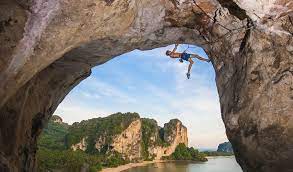
Large parts of Southern China have karst terrain, including some of the most famous tourist areas — Wu Yi Mountain in Fujian, Guilin and Yangshuo in Guangxi, and much of Guizhou province (although the karst areas of Guizhou are much less frequented by tourists). Many people think Chinese paintings of karst terrain are strange stylized representations of mountains and are amazed to discover that China actually has mountains that look like that.
Karst can also erode in such a way that it forms mazes of pinnacles, arches and passageways. The most famous example can be found in the Stone Forest (石林 shi lin) near Kunming in Yunnan.
Talk
The official language of China is Standard Mandarin, known in Chinese as Putonghua (普通话, "common speech"). It has been the only language used in education on the mainland since the 1950s, so most people speak it. Unless otherwise noted, all terms, spellings and pronunciations in this guide are standard Mandarin. As Mandarin is tonal, getting the correct tones is necessary for one to be understood.
Many regions - especially in the southeast and south of the country - also have their own "dialect", all of which are tonal. These are really different languages, as different as French and Italian although referring to Chinese "dialects" as separate languages is a touchy political issue. Of true dialects within Mandarin, pronunciation varies widely and there is often a liberal dose of local slang or terminology to liven up the mix. After Mandarin, the largest dialect groups are Wu, spoken in the region around Shanghai, Zhejiang and southern Jiangsu, followed by Cantonese, spoken in most of Guangdong (Canton), Hong Kong and Macau, and the Min (Fujian) group which includes Minnan (Hokkien) spoken in the region around Xiamen and in Taiwan, Teochew spoken around Shantou and Chaozhou, as well as Mindong spoken around Fuzhou. Most Chinese are bilingual in the local language and Mandarin. A few who are older, less educated or from the countryside may speak only the local dialect, but this is unlikely to affect tourists. It often helps to have a guide that can speak the local language as it marks that person as an insider, and you as a friend of the insider.
Whatever the spoken dialect, the formal written language is always the same. Even Japanese and Korean use many of the same characters with the same meaning. There is a complication in this, however. Mainland China uses "simplified characters", adopted to facilitate writing many years ago. Traditional characters are used in Taiwan, Hong Kong, Macau, and by many overseas Chinese, but also on the mainland in advertising and commercial signs. As a result you will just as often see 银行 (yínháng) as 銀行 for "bank". The simplification was however fairly systematic, which means that all hope is not lost for the traveler trying to pick up some sign-reading skills. On the other hand, native speakers usually do not encounter problems reading either script so learning how to write either one would usually suffice.
Note that in calligraphy, the number of scripts is much more varied as different painters use different unique styles, though these have been grouped into five different styles. They are zhuanshu(篆书/篆書), lishu(隶书/隸書), kaishu (楷书/楷書), xingshu (行书/行書) and caoshu (草书/草書), of which kaishu is the official script used in China today. When calligraphy is written in kaishu, it is usually traditional Chinese characters that are used due to their superior aesthetic value. The casual traveler can easily get by without learning the other four styles though learning them would certainly help those with a deep interest in traditional Chinese art.
In the far western reaches of the country, Turkic languages such as Uighur, Kirghiz, and Kazakh as well as other languages such as Tibetan are spoken by some of the non-Han ethnic minorities. In the northern and northeastern parts, other minority languages like Manchu, Mongolian and Korean are also spoken in areas populated by the respective ethnic minorities. Yunnan and Guangxi in the south are also home to many other ethnic minorities such as the Miao and the Naxi who speak their own languages. However, with the possible exception of the elderly, Mandarin is widely understood in these areas too, and almost all younger individuals will be bilingual in both their minority language and Mandarin. Sadly some of the minority languages such as Manchu are dying out.
See also: Chinese phrasebook, Cantonese phrasebook, Minnan phrasebook
English speakers
Although most Chinese are taught some English at school (in fact, English is compulsory starting from late elementary school), and passing an English exam is a requirement for a university degree, the focus of the instruction is formal grammar and writing rather than conversation. As a result, few learn it well enough to be able to participate in an English conversation. Outside of the largest cities and the major tourist areas, it is quite rare to find locals conversant in English.
That said, a few locals who have studied English as a second language in university (an especially if they studied abroad) generally have a reasonable to very good standard of English.
Useful hint: it's often helpful if you try to simplify your English. Stay away from using complex phrasing like "Would you mind if I come back tomorrow?" and stick to simpler, more abrupt phrasing like "Tomorrow I will return." This brings the phrase closer to its Chinese equivalent, and is therefore not necessarily condescending.
Learning Chinese
See also: Learn
In the West, Chinese has a undeserved reputation for being difficult to learn. While it is very different from English and other Western languages, there is no reason that a traveler cannot learn to speak some basic Chinese. Elementary Chinese grammar is quite simple; the main difficulties are pronunciation and using tones.
Written Chinese is famously complex and requires a great deal of study to master. However, learning to recognize just a limited number of characters will allow you to get information you need. This may even be simpler in Chinese than in languages with alphabetic writing systems, because in those languages you can't understand anything until you know the whole alphabet and acquire the required vocabulary. In Chinese it's relatively straightforward to pick up the characters, say, for "Internet cafe" or "fried noodles," without knowing anything else about the language. If you have a good visual memory, you may even end up knowing what a sign means without being able to pronounce it - a useful skill even if only to distinguish "exit" 出口 from "entrance" 入口. To bridge the gap between recognizing and reading out loud, pinyin was developed, which uses Latin script as an aid to teaching Chinese. Pronouncing pinyin is not intuitive for English speakers, as letters and combinations are not what you would expect, but learning it at even a basic level already has enormous practical value for the traveler.
An understanding of the local dialect - often completely different from standard Chinese (Mandarin) - can be useful when traveling to more remote areas. But in those areas a phrase book that includes Chinese characters will also be a big help, as written Chinese is more or less the same everywhere.
To advance more rapidly in study of the Chinese language, and to learn to distinguish the tones, it might be a good idea to equip yourself with a audio guide to conversation in Chinese. You can find such tools on the Internet.
China souvenirs & shopping
The official currency of the People's Republic of China is the renminbi (人民币 "People's Money"), often abbreviated RMB. The base unit of this currency is the yuan (元), international currency code CNY. All prices in China are given in yuan, usually either as ¥ or 元.
For years, the yuan was pegged at 8.29 to the US dollar, but in 2005 it was floated and has been slowly strengthening ever since. As of December 2008, it is around ¥6.88 to the US dollar.
The official subdivisions of the yuan are the jiao (角), at 10 jiao to the yuan, and the fen (分) at 10 fen to the jiao. The fen is nearly worthless and almost never used nowadays. A coin worth ¥0.10 will thus say 壹角 ("1 jiao"), not "10 fen", on it. But in colloquial Mandarin, people often say kuai (块) instead of yuan, and the jiao is also dubbed the mao (毛). A price like ¥3,7 would thus be read as "3 kuai 7 mao" (although the trailing unit is usually omitted).
When dealing with numbers, note that for example wu bai san, literally "five hundred three", means 530 or "five hundred three tens", with the trailing unit dropped. The number 503 would be read as wu bai ling san, literally "five hundred zero three". Similarly yi qian ba, literally "one thousand eight", means 1800. When using larger numbers, keep in mind that Chinese has a word for ten thousand, wàn (万), and thus for example 50000 becomes wu wan, not wu shi qian.
A lot of Chinese currency will be in the form of bills — even small change. As a general rule, bills are preferred in the north and coins in the south. Even the jiao, at just one tenth of a yuan, exists as both a bill (the smallest) and two different coins. Conversely, one yuan exists both as a coin and as two different bills. You should be prepared to recognize and handle either version.
Counterfeiting is a major problem, especially of ¥50, and ¥100 bills, though even fake ¥10 bills exist. When you buy currency at a bank, ask the teller to check for counterfeit bills. Examine all bills you receive as change. Be suspicious when you get several bills with lower denominations on top. The following are indicators of a possible counterfeit bill: Sharp-edged watermark, No metal strip, Smooth paper, Flat smooth ink, Reflective number on bottom-left of a ¥50 or ¥100 bill is the wrong color, or the color of the reflective number doesn't change when you tilt the bill. The following are indicators of a real bill: Blurry-edged watermark, Metal strip, Rough paper, Raised ink, Reflective number on bottom-left of a ¥50 or ¥100 bill is the correct color, and the color of the reflective number changes when you tilt the bill. Note that old style bills do not have a metal strip or the bottom-left reflective number. Counterfeits often have very (too) bright and luminous colours. It is not considered impolite to refuse bills and to ask to have them changed. Of course, the safest way is to stick with the Bank of China, as they are by far the most trustworthy money changers in China.
Avoid paying for taxi fares with large bills as the driver will need to give you change, and inside a dark taxi it's hard to determine whether bills are real or fake. Try to break your hundreds at larger stores or restaurants so you do not have to accept a fifty (probably the most counterfeited bill).
Changing money
Obtaining RMB in Western countries can be difficult or impossible, and the exchange rates are often unfavorable. It is generally more convenient and economical to obtain RMB in China by using foreign bank cards or traveler's cheques or exchanging major foreign currencies.
Keep all your exchange receipts if you wish to convert your RMB back to your original currency later. This is to ensure that only RMB bought in China is bought back (the economic logic is too arcane to go into here). This includes cash withdrawals from ATMs, and any other exchange medium. Exchanging currency outside of official channels (i.e. if you lose your receipts) is technically illegal, although enforcement of these currency controls is lax, and exchange rates are not any better than through official channels.
ATM cards
Most Chinese ATMs will allow for withdrawals from foreign bank accounts for a small, flat, out of network fee. Before traveling, find out if your home bank charges a currency conversion fee (often between 0-3%) on such transactions. A list of fees charged by major U.S. banks can be found here. It may be worthwhile to open a zero conversion fee account beforehand (such as through an online banking institution) for the purposes of your trip. Whichever bank you use, you will likely need to contact them before your trip and tell them to allow ATM withdrawals from China (as these actions might be flagged as suspicious and blocked otherwise). Be sure to specify if you plan to make transactions in Hong Kong, Macau, or Taiwan as well, as your bank may consider these regions separate from Mainland China.
In recent years the official exchange rates have been close to market value, so official exchange rates can provide amounts similar to, or better than, unofficial ones. The airports in Beijing and Shanghai have cash machines which accept most international debit/credit cards. Be sure to check for the Plus or Cirrus symbols (whichever your bank supports; those on the PULSE network can use most UnionPay ATMs, a slight edge over the rest), as there are many ATMs which are not linked to international networks and may retain your card, a very unpleasant prospect.
Some machines that show the Maestro or Visa or Cirrus signs will not necessarily deliver cash for a foreign card. However an adjacent, apparently identical machine in the same bank lobby may work. If you cannot get cash from one machine, just try another.
If you have trouble because the ATM requires a 6 digit PIN and you only have 4 digits, try 2 leading zeroes (although this may not be necessary - try your actual PIN first). Also, when venturing into more remote regions, it is advisable to carry sufficient cash, as ATMs with international network access may not be available. If you find yourself in a town with a Bank of China branch but no international network-capable ATM, it may be possible to get a cash advance on a credit card inside the bank. Just ask.
Travelers cheques
Foreign currency and/or traveler's cheques can be exchanged into RMB in most banks as well as decent hotels in major cities with varying levels of difficulty, and you will be required to show a passport or identification. Your signature on your passport will be compared with the signature on the traveler's cheques, and your cheques and passport itself may be scrutinized to be sure of authenticity. If the signatures aren't an exact match you may be denied, or it might take a lot of persuading on your part. Providing a receipt with a matching signature may help. Using dual signature travelers cheques such as those provided by American Express can cause quite a hassle if both parties aren't present. As well, carrying travelers cheques for a currency other than your own causes suspicion and concern even at major banks. A Canadian citizen using American travelers cheques took almost two hours to cash them at a major branch of the Bank of China. However, traveler's cheques get much better exchange rates than cash when exchanged at a branch of the Bank of China.
Cash to cash conversions
Exchanging US currency for RMB can be much simpler, but expect the bills to be heavily scrutinized before the exchange is processed. Opportunities to buy RMB before entering China, for example when coming overland from Hong Kong or Vietnam, should be taken, as the rates are better. The same is true going the other way - selling just across the border will often net a more favourable rate. Also, most banks will allow you to get a cash advance via a debit or credit card. It's useful to carry an international currency such as British Pounds, US Dollars, or Japanese Yen to fall back on should you not have access to a cash machine.
Counterfeiting is a major issue when exchanging money in China. While exchange rates may look attractive, unless you have a local friend to help you out, do not exchange money at private money changers. It is not uncommon to exchange a large amount of cash only to find that most of what you got is fake. Stick with the Bank of China or one of the other large banks as even though you get slightly worse rates, the risk of getting counterfeit bills from them is close to zero.
Electronic transfers
Electronic money transfers to another country are difficult. Most banks don't offer this service; you need the main branch of Bank of China, and even they may not do it except in major cities. Service charges are high, the staff is often not properly trained, and the process can take up to a week.
It will be MUCH easier if you have an dual-currency account with the Bank of China - opened at the branch from which you plan to get your money. Electronic transfers to dual currency accounts incur no or very low fees although it still will take about one week. All you need to start is your passport and visa and a small initial deposit (can be RMB) plus the new-account fee (¥10-20).
Western Union have deals with China Agricultural Bank and with China Post so there are a lot of Western Union signs around. This is what overseas Chinese sending money to relatives, or expats sending money out of China, generally use; it is generally easier and cheaper than the banks. There may, however, be problems. Their "system" may be "down" or the employee you deal with may ask for silly things — for an overseas transfer, the recipient's passport number and visa number; for a within-China transfer, cash in US dollars. Just try another branch.
If you open a foreign currency account or a dual currency account, check if you will be able to access it in another province (e.g. the Bank of China does not allow this as of 2006).
Credit cards
Outside of hotels, major supermarkets, and high-class restaurants, credit cards are generally not accepted (not even in places such as KFC), and most transactions will require cash. However, those with Discover credit cards will find that their card is much more widely accepted (under the UnionPay system) than those with Visa/Mastercard/AmEx. Most convenience stores take UnionPay, as do most restaurant chains, stores selling high-value items, grocery store chains, and most ATMs. Beware of pickpockets.
Many stores have point-of-sale terminals for Chinese bank cards; typically these will not work for foreign cards (because of the nature of Discover's agreement with the UnionPay network, it is treated as a domestic card at ATMs and point-of-sale). If you are going to spend a lot of time in China and use significant amounts of money, consider getting a Chinese bank account.
In the vast majority of cases, price of goods already have Value-added Tax (VAT), and any sales tax included, so anything with a marked price tends to be sold at that price or slightly below, but there is large room for bargaining if there is no stamped price. If you are buying anything which is not from a fixed price store, bargaining is normal, though you may get a better price if you let a local person do the buying for you. Vendors will charge the lowest price to local people (who can speak the dialect), next lowest price to other Chinese nationals, and the highest price to foreigners. Bear in mind, however, that some middle and upper class locals may not be willing to bargain as mercilessly as you would. If you want to get the best price possible, arrange for a friend to visit the site and make the purchase without you. Even if a Chinese person is doing the bargaining, the sight of a foreigner will inflate the price.
Many visitors come looking for antiques, and hunting in the flea markets can be great fun. Be aware however that the overwhelming majority of the "antique" items you will be shown are fakes, no matter how convincing they look and no matter what the vendor says. Should you have bought a real antique you may be in for some serious trouble (See Antiques below). You are advised not to spend serious money unless you know what you are doing, since novices are almost always taken for a ride.
Costs
Unless you are heading to Hong Kong or Macau, China is generally a cheap place to visit. That is if you eat the local food, use public transport and stay in a decent hotel. ¥100 is a perfectly serviceable daily backpacker budget. However, if you want to live an extravagant lifestyle and eat only Western food, even ¥1000 a day may not be enough. There is widespread variation in prices depending on where you go, with big cities like Shanghai, Beijing and Guangzhou generally costing more than the rural, more inland parts of the country. Shenzhen and Zhuhai are also known for being expensive by Chinese standards (which is still relatively cheap by Western standards) as many residents of Hong Kong and Macau, who are generally more affluent than their mainland Chinese counterparts, often go there to shop.
Tipping
Although tips will be accepted if given, keep in mind that the Chinese, for the most part, don't tip at all for common services such as taxis, haircuts, deliveries, massages, food or bar service. A tip might be a nice idea if someone goes way out of their way for you or if they provide exceptional service beyond what they're required to do in their job. It may also be a good idea for a driver or tour guide on a multi-day trip. A bellhop at a nice hotel might expect a tip. Otherwise, tipping is not necessary and will only condition the Chinese to expect extra money from foreigners.
Banking
Opening a bank account in China - especially an RMB-only account - is a very straightforward process. You only need your passport with a valid visa (tourist visas are acceptable). For long-term travel or residence, a Chinese bank account is a very good idea. Your ID and PIN are required for withdrawals at the counter although deposits can be made no questions asked if you have the bank book they issued with your account. Banks usually charge a fee (around 1%) for depositing and withdrawing money in a different city than the one you opened your account in. ATMs are now present in almost all towns and cities except in the most remote areas. Many ATMs accept Visa, Mastercard, AMEX, Maestro, and Plus debit and credit cards although some only accept Union Pay cards.
Bank of China The Bank of China is probably the most useful bank for travelers and foreigners living in China. Bank of China ATMs are often the only ATMs where a foreign bank card will work. Many branches have English-speaking staff and the bank has the authority to deal with foreign currencies, unlike many of the other banks. Almost all cities, big and small, have a branch but not all have ATMs or currency-exchange services. However, some remote areas have no branches even in larger towns so be prepared for such situations. Opening an account with the Bank of China costs only ¥1 and the minimum initial deposit is only ¥1 but you will be charged ¥15 if you want a Union Pay debit card. You will receive a bank book as standard in which will be recorded all transactions and balances - including foreign currency balances. The Bank of China is also the best choice for sending and receiving bank transfers as it is quicker than other banks.
Shopping
China excels in handmade items, partly because of long traditions of exquisite handmade items, partly because labor is still cheap relative to other countries. Take your time, look closely at quality and ask questions (but don't take all the answers at face value!)
- Porcelain with a long history of porcelain making, China still makes great porcelain today. Most visitors are familiar with blue and white, but the variety of glazes is much greater, including many lovely monochrome glazes which are worth seeking out. Specialist shops near hotels and the top floors of department stores are a good place to start, though not the cheapest. The "antique" markets are also a good place to find reproductions, though it can be hard to escape from attempts to convince you that the items are genuine antiques (with prices to match). Two of the most famous centers for porcelain are Jingdezhen and Quanzhou.
- Furniture in the last 15 years China has become a major source of antique furniture, mostly sourced from China's vast countryside. As the supply of old items dwindles many of the restorers are now turning to making new items. The quality of the new pieces is often excellent and some great bargains can still be had in new and old items. Furniture tends to be concentrated in large warehouses on the outskirts of town, Beijing, Shanghai and Chengdu all have plenty of these. Hotels will tell you how to find them. They can also arrange shipment in most cases. Zhongshan has a huge furniture market.
- Art and Fine Art the art scene in China is divided into two non-interacting parts. On the one side there are the traditional painting academies, specializing in "classical" painting (bird and flower, landscapes with rocks and water, calligraphy), with conservative attitudes and serving up painting that conforms to the traditional image of Chinese art. On the other hand there is a burgeoning modern art scene, including oil painting, photography and sculpture, bearing little relation to the former type. Both "scenes" are worth checking out and include the full range from the glorious to the dreadful. The center of the modern scene is undoubtedly Beijing, where the Da Shan Zi (sometimes called 798) warehouse district is emerging as the new frontier for galleries, reminiscent of New York's Soh